Game Mechanics, Swarm AI & Logistics
Unlike casual tower defense games, Zombies Aren't Real operates on an organic city-scale contagion model with strict ballistic sightlines, logistical supply rules, and GIS spatial topology.
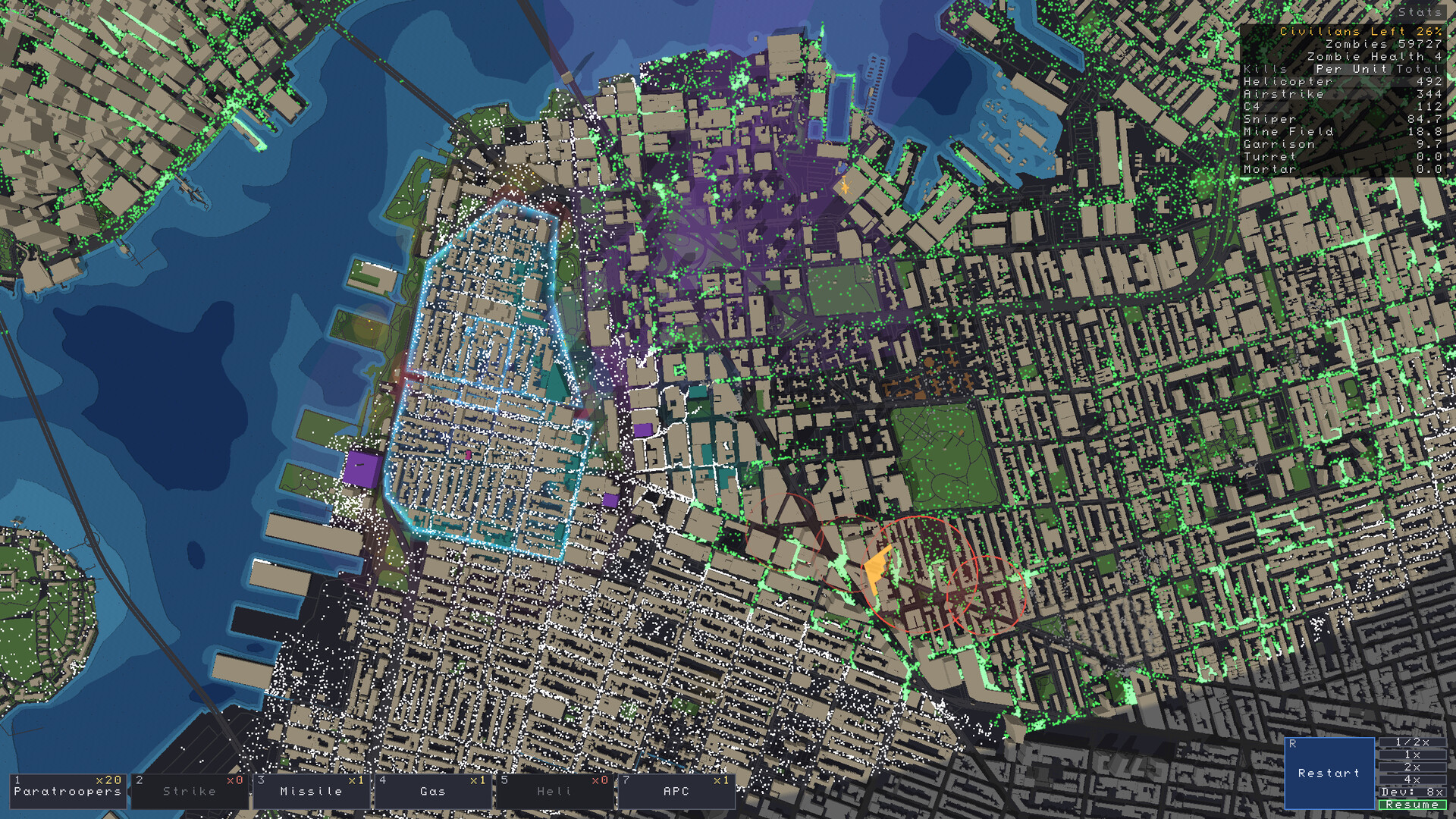
True Ballistics & Sightline Occlusion
Bullets do not curve or penetrate reinforced concrete buildings. If a 12-story high-rise sits between your rooftop sniper and the horde vanguard, your sniper will not fire a single round. Always verify 3D height angles with hotkey [V].
◈ ESSENTIAL TACTICAL HOTKEYS & SHORTCUTS
Master these keystrokes to inspect terrain and place defensive infrastructure without opening slow submenus.
| HOTKEY | FUNCTION | STRATEGIC PURPOSE |
|---|---|---|
| H | Toggle 3D Building Height & Topography View | Check sniper rooftop vantage elevation & mortar arc clearance |
| V | Vertical Sightline & Height Cross-Section | Verify line-of-sight obstruction between skyscrapers |
| K | Construct Fortified Wall ($10) | Seal off side alleys and funnel horde paths |
| G | Construct Security Gate ($25) | Create one-way civilian evacuation valves |
| U | Open Pre-Mission Loadout Panel | Spend Skill Points (SP) on vehicles, air support, and specialized units |
| Space | Tactical Pause / Game Speed Toggle | Analyze breach points and issue emergency reposition orders |
| 1 - 4 | Select In-Mission Tactical Air Support | Trigger Paratroopers, Precision Missile, Gas, or Chopper |
Infection Vector & Zombie Health Scaling
How the undead infection spreads through urban infrastructure and why early containment is exponentially easier than late-stage triage.
Purple Blocks (Infection Foci)
Purple-highlighted structures represent active outbreak centers. These buildings produce continuous waves of infected entities at fixed time intervals until all internal pathogen reservoirs are burned or suppressed.
Grey Blocks (Civilian Centers)
Grey structures represent intact civilian dwellings. If a zombie reaches an unfortified grey building, the residents inside are converted one-by-one into fresh infected, causing the swarm size to explode exponentially.
Zombie Health Progression
In early missions, baseline infected possess 2 HP and can be dropped by a single marksman rifle round or garrison burst. In later scenarios and Hardcore mode, zombie health scales upward (3 HP, 5 HP, armored infected), necessitating upgraded Mortars ($150) and heavy sentries.
Acoustic & Visual Aggro
Zombies are attracted by gunfire, explosions, and screaming civilian columns. Firing high-caliber unsuppressed weapons pulls infected from neighboring streets into your defensive line.
Safe Zone Logistical Supply Aura
The foundational game mechanic governing weapon fire rates, reloads, and tactical viability.
Unlimited Ammo & Instant Cycles
Combat units inside an unbroken Safe Zone perimeter are continuously fed munitions from central civil defense depots, enabling zero-delay reloads.
12-Second Deployment Penalty
Any unit deployed or displaced outside the designated Safe Zone experiences a 12-second combat-readiness penalty before firing their initial shot, and operates with limited ammo clips.
Perimeter Integrity Collapse
If a wall segment is destroyed or an open gate breached, the entire Safe Zone enters a degraded state, temporarily cutting infinite supply until the breach is resealed or fallback lines are manned.
GIS Satellite Elevation & Water Barriers
How real-world geographic data creates organic tactical obstacles and killzones.
Building Heights (Press H / V)
Every building in Zombies Aren't Real possesses true-to-life vertical height based on global OpenStreetMap and Overture spatial data. Elevated vantage points grant unobstructed line-of-sight and projectile range multipliers.
Water as Natural Armor
Rivers (Hudson, Seine, Grand Canal) are 100% impassable to zombie hordes. Incorporating riverbanks into your perimeter eliminates entire defensive sectors for zero cost.
Slope & Gradient Resistance
Steep inclines (such as San Francisco's hills) apply a 35% movement penalty to ascending zombies, while granting descending military vehicles and downhill fire teams tactical advantage.
Online Co-Op & Steam Workshop Level Editor
Collaborative tactical command and community scenario creation.
Two-Player Online Co-op
Command military forces collaboratively with a partner in real-time. Players share the map, synchronize defense perimeters, and coordinate combined air-ground operations.
Built-In Level Editor
Import geographic coordinates for any city on Earth. Set initial budget, civilian density, outbreak epicenters, and custom wave timers, then publish directly to the Steam Workshop.
Global Leaderboard Scoring
Scoring is strictly tied to civilian survival percentage, mission completion speed, and budget conservation across Normal, Hardcore, and Ultra Hardcore ladders.